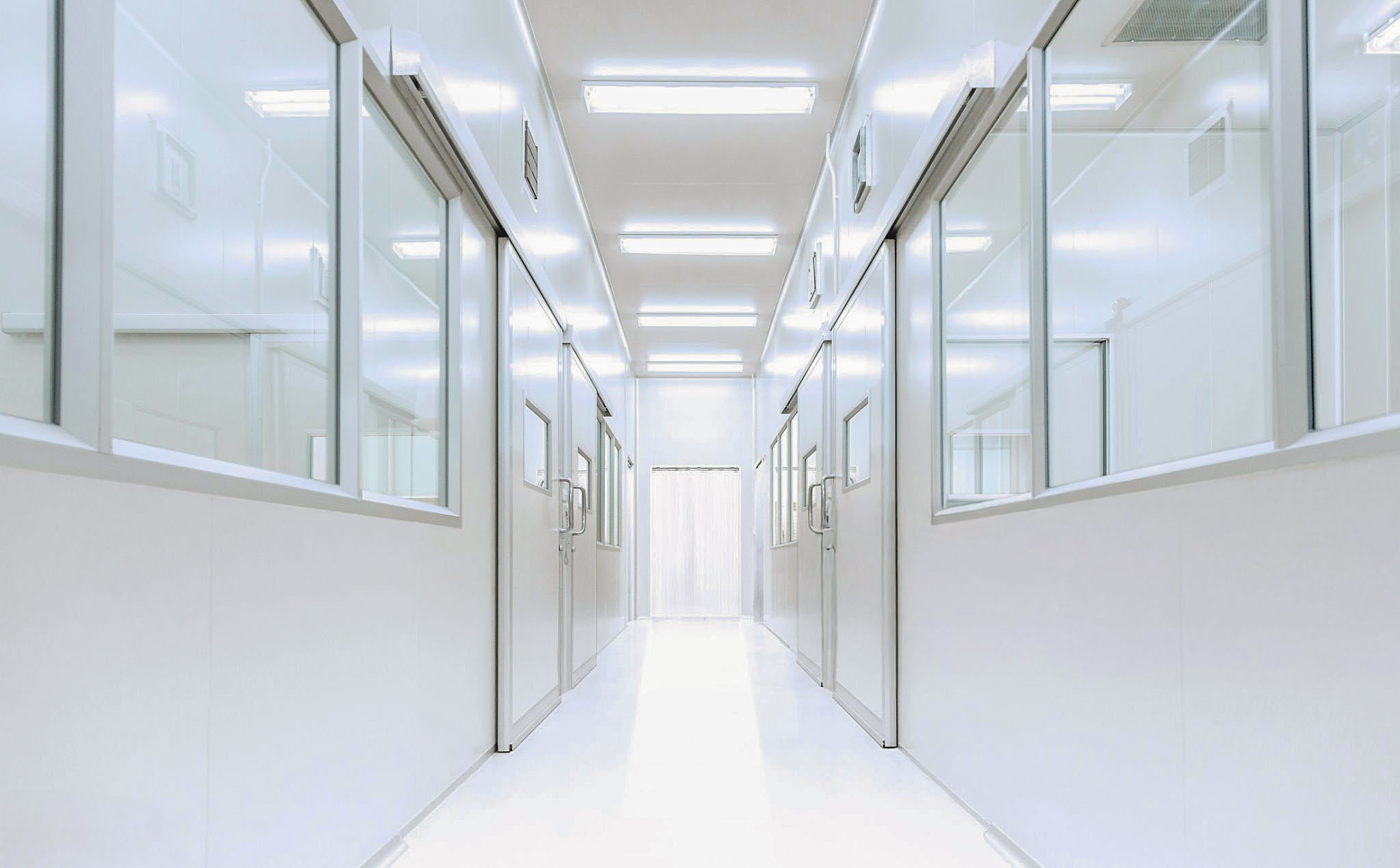
Cleanrooms and cold rooms are controlled environments designed to protect products, processes and people by maintaining critical parameters such as airborne particle concentration, temperature and humidity. Outside these environments, those parameters vary with location and season. In both types of facility, interior surfaces contribute to environmental control, while cladding requirements depend on how the space is used.
These different demands call for materials with specific properties. Vetroresina’s hygienic glass-fibre-reinforced polyester laminates and its other solutions for this sector are designed to meet these requirements.
Cleanrooms: controlling contamination
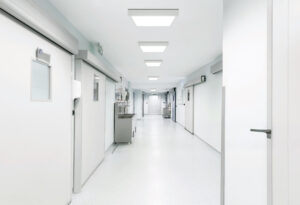
Operating room corridor
A cleanroom is an environment in which airborne particles are kept at extremely low levels and conditions such as temperature, humidity and airflow are tightly controlled. Cleanrooms are used in many sectors, including pharmaceuticals, pharmacy compounding, medical devices, biotechnology, food and beverage production, electronics manufacturing and aerospace.
When specifying interior cladding, a key consideration is reducing the risk of surfaces becoming a source of contamination. Walls and ceilings therefore need to be:
- Non-porous, because porous surfaces retain particles and microorganisms and cannot be reliably sanitised.
- Easy to clean, because sanitisation is a daily task and surface properties directly affect cleaning time and costs.
- Resistant to wear and chemicals, because cleaning protocols frequently involve strong detergents and disinfectants.
- Designed to minimise joints and places where dust can collect, because dirt can settle at each joint and be difficult to remove completely during sanitisation.
Cold rooms: hygiene and demanding conditions
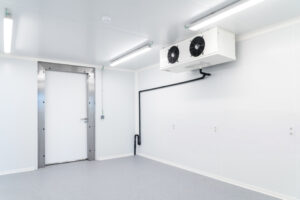
an empty industrial room refrigerator with four fans
Cold rooms are refrigerated spaces used to store temperature-sensitive goods, such as food and medicines, including at sub-zero temperatures. Storage conditions are maintained by keeping the operating temperature constant within a thermally insulated, hygienic enclosure.
In cold rooms, hygiene requirements are compounded by moisture, repeated washing and thermal stress. Cladding materials must retain their properties over time despite frequent cleaning and sanitisation, providing both hygiene and durability. In spaces used to store food, suitability for direct food contact is also required. For Vetroresina’s GRP laminates, this property has been tested and documented.
Three factors to consider
- Fewer joints, more continuous surfaces. For a given material, the use of larger sheets reduces the number of joints and makes surfaces easier to clean and sanitise. Sheet size therefore affects both hygiene and operating costs.
- Durability over time. Detergents, pressure washing, impacts from trolleys and temperature fluctuations place cladding under constant strain. Material strength, long-term stability and the ability to repair damage quickly without compromising hygiene or appearance are important factors when selecting a product.
- Refurbishment can be an alternative to replacement. In many cases, deteriorated cladding can be refurbished by applying a new laminate over the existing substrate. Direct bonding to EPS, XPS and polyurethane insulation substrates is also possible. Where the condition of the substrate allows, this approach can reduce installation time and operational downtime compared with complete replacement.
The performance of GRP laminates
Vetroresina’s hygienic glass-fibre-reinforced polyester laminates are designed to meet this combination of requirements. High-gloss embossed surfaces facilitate cleaning, while the gelcoat provides resistance to UV radiation and weathering. Large sheet sizes also help reduce the number of joints.
Waterproof properties, low thermal expansion and resistance to corrosive agents contribute to the durability of the cladding, including in marine environments or areas exposed to salt spray. The laminate can also be applied to curved surfaces. Its impact resistance is complemented by the ability to repair the material if damaged.
For controlled environments, Vetroresina offers several solutions, including the Vetroshield range for the interior cladding of cleanrooms, pharmacy compounding laboratories and cold rooms..
The ANTIBAC antimicrobial treatment is available on request. This silver-based technology is incorporated into the gelcoat during production and distributed evenly across the surface. It helps reduce microbial load in frequently touched areas and prevent new colonies from developing, providing protection throughout the product’s service life.
A range of dedicated solutions
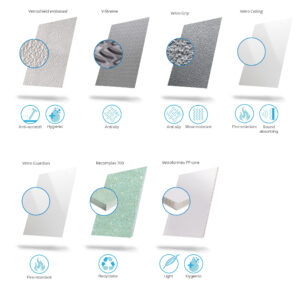
The range for controlled environments includes products with complementary functions that can be combined according to the different areas of a facility:
- Vetroshield embossed – Scratch-resistant, hygienic
- V-Streme – Slip-resistant
- Vetro Grip – Slip-resistant, wear-resistant
- Vetro Ceiling – Flame-retardant, sound-absorbing
- Vetro Guardian – Flame-retardant
- Recomplax 700 – Recyclable core
- Vetroformex PP core – Lightweight, hygienic
Material selection depends on the application and the required performance: hygienic cladding for walls and ceilings, slip-resistant laminates for floors, products with specific reaction-to-fire performance, and core materials for sandwich panels. Technical data sheets for individual products are available on request.